From Teacups to Highland: A Tinker’s Journey
I've been tinkering with things since the day I arrived in Second Life. It doesn't matter whether it's a script, a building, a texture or something else entirely. If there's something I can take apart, change or improve, chances are I'll have a go at it.
Read the whole postShow less
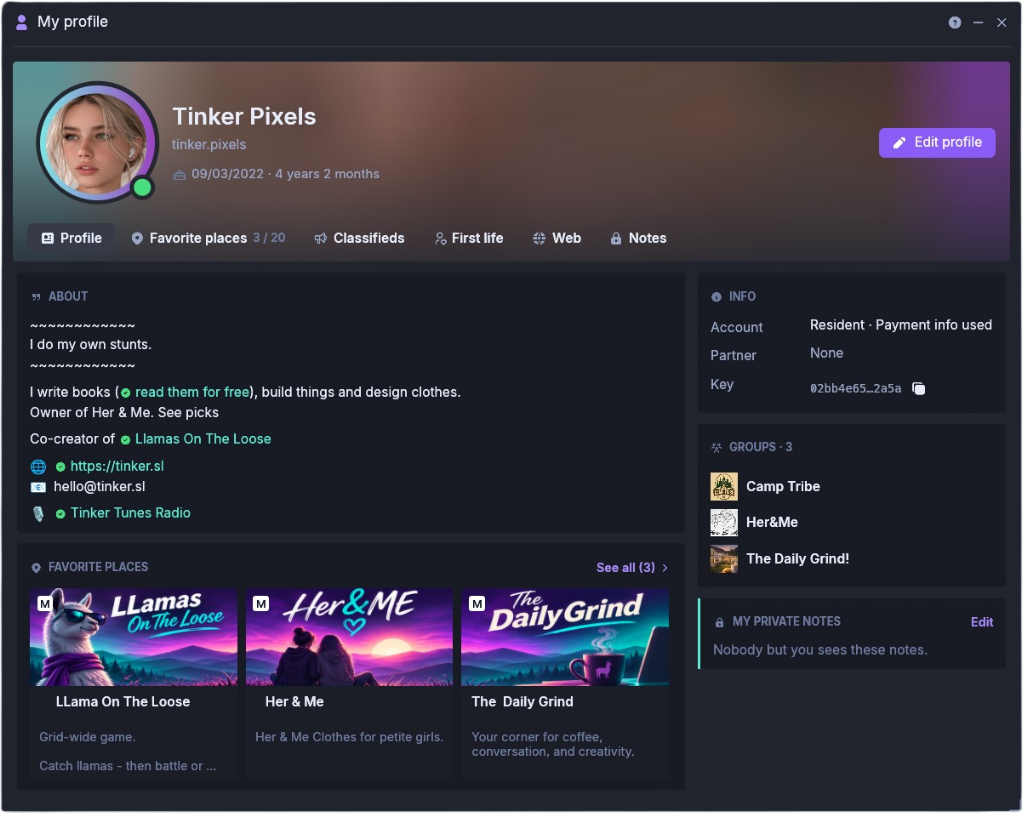
In the beginning, it was mostly little standalone projects. Perhaps I needed a HUD that didn't exist, or one that did but cost more than I was willing to pay. Sometimes I simply wanted something nobody else had. Whatever the reason, I usually ended up trying to make it myself.
Eventually, I became curious about boats. I picked up a few freebies here and there, and while they were perfectly good for getting started, I soon discovered that free boats were often rather old or limited in what they could do. So off I went to a boat shop, only to discover that people were charging thousands of Linden dollars for a single boat. Even the smallest one, a cute little dinghy, cost L$1,200!
That was when I decided it was time to learn how to make something a little more complicated.
I took a few screenshots of the dinghy, headed off to a sandbox and started putting prims together. I nicked a sail from another boat, wrote a script to make the thing move, found some full-perm bits and pieces such as ropes and buoyancy devices, and linked the whole lot together.
And that became my first proper creation.
I called it The Teacup, partly because the first shape I'd made for the hull was a hollow semicircle that looked remarkably like a teacup. The name stuck, even after the boat had stopped looking quite so much like something you'd find in a kitchen cupboard.
From there, I moved on to aeroplanes, cars and all sorts of other things. Nothing that could compete with the professionals, mind you, but that wasn't really the point. These were things I'd made myself. I could change every little detail, fiddle with whatever I fancied and make them work exactly the way I wanted.
And somewhere along the way, a thought occurred to me.
Why couldn't I do the same with my viewer?
After all, why should I have to use an interface designed around somebody else's preferences? Why couldn't I make one that suited me?
I started with a custom skin, since that seemed the most accessible way of going about it. It certainly came with its fair share of restrictions and limitations, but at least I could see the results of my efforts. A different colour here, a button removed there. Each time I logged in, something looked a little different.
Before long, I'd become rather obsessed with hiding as much of the interface as possible.
Not the things I actually used, of course, but all the clutter and unnecessary duplication. You've probably noticed that viewers tend to offer at least two different ways of doing almost everything. Sometimes three or four. I didn't particularly want that. I wanted an interface that showed me what I needed and otherwise stayed out of my way.
Unfortunately, there was only so much I could accomplish by editing XML files. Some things simply couldn't be changed or removed without touching the actual code, and I became increasingly curious about how that worked.
Then, in the summer of 2026, I finally managed to set up everything I needed to compile my very own copy, or fork, of Firestorm.
And let me tell you, getting the development environment working was considerably more difficult than actually changing the viewer afterwards!
But now I could really get stuck in.
I could remove tabs I didn't need, redesign the top menus to my heart's content and change all sorts of things that had been bothering me for years. More importantly, I could finally add entirely new functionality.
For instance, I could now assign local labels to objects in my inventory. Think of them as display names for objects. Instead of having to remember whatever obscure name the creator had decided to give something, I could simply call it whatever made sense to me.
I also added a scanner for scripted objects worn by other avatars, sorting them from highest to lowest impact. There were plenty of other additions too, ranging from tiny quality-of-life improvements to more substantial changes.
Some of these were things I'd wanted for years. Others were ideas that occurred to me while working on something completely different.
Before I knew it, my viewer had become different enough from Firestorm that I decided it deserved an identity of its own. A new name, new icons, a new login screen. The lot.
And so Horizon was born, my first Firestorm fork.
Things moved rather quickly after that. For a while, I was adding, removing and changing just about every aspect of the viewer, all in pursuit of making it perfect for one particular individual.
Me.
Eventually, I renamed the result Oasis, and that became my viewer of choice for a while.
Then Aurora came along.
At first, it was little more than whispers. Something new was happening. A different viewer was on the way. Something interesting, apparently.
To be fair, I didn't pay it much attention.
I try to keep up with what's happening in Second Life, and I'd like to think I'm a reasonably knowledgeable resident when it comes to the platform and its various quirks. But that also means there's always something new being talked about, and not every exciting announcement turns out to be quite as exciting as people make it sound.
Curiosity eventually got the better of me, though. After hearing from a few close friends that Aurora really was something different, I decided to install it and have a look.
And goodness, they weren't exaggerating.
Not only did Aurora introduce a different approach to rendering the world, but it also offered a genuinely fresh take on the user interface.
For years, viewers have followed more or less the same conventions. Alchemy, Firestorm and the official Second Life Viewer all have their own flavours, of course, but underneath the individual tweaks and refinements, much of the underlying logic remains familiar.
Aurora seemed determined to question quite a lot of that.
The traditional top bar? Gone. Instead, information was presented in small, separate elements dotted around the interface. The conversations window felt completely different, looking more like a modern messaging application, complete with profile pictures.
It was unfamiliar, certainly, but in a rather refreshing way.
I was hooked.
Naturally, it wasn't long before I started wondering what I could change.
I began bringing across the fixes and features I'd developed for Firestorm over the previous few months. Some required a little reworking, while others fitted into Aurora's structure surprisingly well. And, as before, one change tended to lead to another.
It didn't take long before the end result began to feel rather different from the viewer I'd started with.
This wasn't simply Aurora with a handful of tweaks any more. It was becoming something that reflected my own preferences, ideas and way of doing things.
Which, of course, meant I needed another name.
After considering quite a few possibilities, I eventually settled on Highland.
There were several reasons for choosing it, but I particularly liked how it looked and sounded. It also seemed to fit rather nicely with the landscape-inspired identity I'd been developing for the viewer.
Underneath it all, Highland is still very much Aurora. I'd estimate that around 99% of the underlying code is identical, and I have no intention of pretending otherwise. Aurora provides the foundation, and a rather impressive one at that.
But Highland has developed its own character.
It looks different, feels different and, perhaps most importantly to me, does things that no other viewer on the grid currently does. Not because those features are necessarily revolutionary, but because they're things I wanted, things I imagined and things I built for myself.
And that's really what this whole journey has been about.
From a rather questionable little dinghy made out of borrowed bits and pieces to an entire Second Life viewer, the motivation has never changed very much.
I see something I like. I wonder whether I could make it better suited to me. And then I start tinkering.
At the time of writing, Highland isn't available for download, and it may never be. Given that I've removed quite a bit of functionality as well as adding my own, it probably wouldn't be the right choice for most people anyway.
But that's perfectly fine.
After all, I never set out to build a viewer for everybody.
I set out to build one for me.